

Dr. Jeff Grognet DVM & Dr. Louise Janes May 2008
Current Article ∙ Archive ∙ Back to Island Voices
Chemotherapy for Cats Comes of Age
by Jeff Grognet and Louise Janes
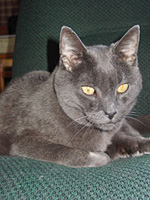
Jasper was a male gray of thirteen years. He was incredibly thin and had a poor hair coat. But he was not the typical gaunt cat that lies slumped on the examination table. Jasper was looking at everything. He had so much life in him, he wouldn’t keep still.
My first thought was that Jasper may be a diabetic. I asked if he was drinking more than normal. The owner said no. This seemed to quash this idea. Diabetics drink many times what a normal cat should–their litter box is always wet.
The owner did tell me that Jasper had a great appetite. In fact, he ate three times what her younger cat ate. This did not make sense–he was so thin.
After spending a lot of time getting nowhere, one of the residents came in to help. She simply looked at the cat and quickly pronounced “hyperthyroidism”. I had not even heard of the disease.
Hyperthyroidism was only discovered a year earlier, in 1979. At the time, diagnosis and treatment of hyperthyroidism was still in its infancy. Now, this disease is seen with unfaltering regularity. Behind kidney failure and cancer, it ranks high on the list of feline geriatric diseases.
A simple blood test confirmed what the resident suspected. Jasper had hyperthyroidism. He had a tumour in his thyroid gland.
First some background. Cats (and people) have paired thyroid glands, one on each side of the windpipe. Their purpose is to manufacture thyroid hormone, a hormone required for growth. Without it, a cat would not grow, it would be a dwarf.
Once a cat is an adult, the thyroid glands play another role, but just as important. Thyroid hormone controls the metabolic rate. If there is excess hormone in the blood (as it is with hyperthyroidism), the metabolic rate is pumped up.
Hyperthyroid cats burn calories so fast they can’t maintain their body weight. The result is a starving, emaciated cat with an incredible appetite.
The question is, how do you treat a cat with a thyroid tumor? Though not malignant (it won’t spread to other areas of the body), it is still a growth. The growth must be removed or controlled.
The “old” way (and at one time, the only way) to help cats with thyroid tumors was chemotherapy. Unlike typical “chemo” in people, the side effects are minimal with anti-thyroid medications. The hair loss and illness we associate with it don’t exist. Anti-thyroid medications are good at controlling hyperthyroidism, but they are not a cure. Medication has to given life-long.
In about 1984, surgery was attempted to remove the diseased glands. Removal of the thyroid glands (thyroidectomy) was previously considered impossible. It was feared that there would be too many side effects if the gland was removed.
Thyroidectomy is now considered routine and has helped countless cats. But thyroidectomy has one major drawback, it can only remove growths in the thyroid glands. Growths in other locations will be missed. Often, thyroid tumours can be found around the lungs.
Now we have a new way to treat hyperthyroidism–radiation therapy. It is a technique that has been used in people for years and now has been adapted to cats. Several veterinary colleges have facilities to provide this type of treatment.
In this procedure, radioactive iodine is injected in a vein. Iodine circulates in the blood and is absorbed by the active thyroid tumour cells. Since it’s radioactive, tumour cells surrounding it are killed. Normal thyroid cells are not as sensitive and are spared.
Radioactive iodine has one enormous plus. Hyperthyroid cats are typically older, ranging from 10 to 19 years. Some do not handle anesthetics well. With iodine, old cats do not have to undergo surgery. A second advantage is that the iodine also kills any tumour cells that surgery would miss.
There is one small drawback with radiation therpay. Cats treated with radioactive iodine are kept in hospital while their “radioactivity” level drops. This takes about a week. People treated identically can go home immediately.
The success with radiation therapy has been gratifying. Cats immediately start to put on weight and their appetite gradually returns to normal. They go home to live a normal life.
Just so you know, Jasper had chemotherapy and did very well. He doubled his weight in a few months and was doing fine two years later when I left veterinary college.
For more information contact Dr. Jeff Grognet or Dr. Louise Janes at
Mid-Isle Veterinary Hospital
5-161 Fern Road West
Qualicum Beach, BC
Tel (250) 752-8969