

Dr. Jeff Grognet DVM & Dr. Louise Janes DVM March 2009

Current Article ∙ Archive ∙ Back to Island Voices
Feline Acne
by Jeff Grognet, DVM, BSc (Agr) and Louise Janes, BSc(Agr), DVM
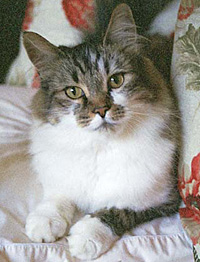
We see acne in many of our feline patients. We often notice early lesions on routine health checkups. Comedones, commonly called blackheads, may be present on the lower chin and occasionally on the upper lip of cats. Many owners don’t notice these or may just ignore them. Because a few comedones can progress to a serious painful condition, it is important to deal with the problem when it is first recognized.
The reason that comedones occur just on the chin has been debated between veterinarians for decades. According to Dr. David Gribble, a veterinary pathologist, sebaceous glands are more concentrated in this location compared to other parts of the body so there are just more to get plugged.
Poor grooming habits and the inability of cats to effectively clean their chins also play a role. Finally, just as with people, stress is involved in the development of acne in cats.
When a sebaceous gland is plugged and unable to drain, it swells and subsequently becomes infected. It then ruptures under the skin surface and causes a “foreign body” like reaction. This causes obvious swelling and pain. Infected fluid will eventually exude from the area through a draining hole.
Feline acne is different from the human equivalent because in people the primary lesion is an infection. In cats, the glands become obstructed first, then bacteria invade.
Dr. Margie Scherk-Nixon, who owned a cats-only hospital in Vancouver B.C., also sees this condition quite often. Scherk admits that she doesn’t know all the reasons why feline acne strikes some of her patients but she does feel that plastic plays a role.
Scherk recommends that all plastic be removed from the environment of feline acne patients. This means replacing plastic food bowls with glass, ceramic, or metal bowls and taking away the plastic placemat from under the bowls. She also recommends that owners cover the area under their cats’ eating area with fabric (if it is linoleum). The plastic hood from a covered litter box should also be removed.
Scherk’s success with this approach implies that some cats have an allergy or hypersensitivity to plastic. Scherk also puts her feline acne patients on hypoallergenic diets. When managed in this way, Scherk’s patients suffer from fewer flare-ups though their disease is not necessarily eliminated.
Pathologists have not found evidence of an allergic reaction in the chin acne samples. They feel there are multiple factors involved in the development of feline acne. The bottom line is that feline acne is a poorly understood disease. Though allergies may or may not play a role, it seems sensible to try eliminating plastic from the environment of every feline acne patient.
To prevent severe flare-ups, owners should cleanse their cat’s chin skin as soon as the first comedones appear. We recommend using an antibacterial skin cleanser to kill the bacteria on the skin that can invade plugged glands. Irritating products must be avoided. Some of the anti-seborrhea shampoos are too harsh for feline skin. We also recommend applying mupirocin (BactrobanR) ointment topically to the chin to help reduce the bacterial load.
When swelling is a problem, the chin can be hot packed for 10 to 15 minutes with Epsom salts (two tablespoons in 4 cups water). Benzoyl peroxide is excellent at flushing out follicles but for some cats, it is too drying. Some owners use human acne cleansing pads on their cats periodically.
Cats with deep-seated lesions may require oral antibiotics to resolve the bacterial component of their disease. Some veterinarians do a culture first to isolate the bacterium and determine which antibiotic will be the most effective.
Fatty acid supplements may also be beneficial to some cats with chronic acne. They help to normalize glandular secretions which hopefully prevents the glands from plugging. These products are available from veterinarians.
When feline acne cannot be controlled with these protocols, the damaged skin of the chin should be biopsied. In some of these difficult to treat cases, Scherk has found yeast infections, ringworm, and occasionally, severe scarring which prevents deep-seated infections from draining. When scarring is advanced, corticosteroid administration may be beneficial in reducing swelling and pain.
Feline acne should be taken seriously. Early intervention is important because the more chronic it becomes, the more difficult it is to treat and the more painful it is for your cat.
For more information contact Dr. Jeff Grognet or Dr. Louise Janes at
Mid-Isle Veterinary Hospital
5-161 Fern Road West
Qualicum Beach, BC
Tel (250) 752-8969