

Dr. Jeff Grognet DVM & Dr. Louise Janes DVM September 2010

Current Article ∙ Archive ∙ Back to Island Voices
Bone Tumours
by Jeff Grognet, DVM, BSc (Agr) and Louise Janes, BSc(Agr), DVM
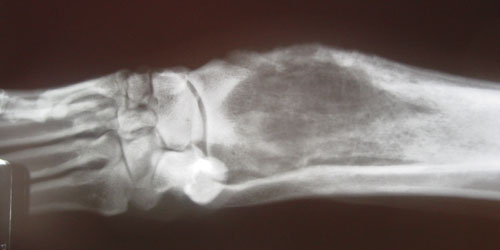
Osteosarcoma (OS) strikes mainly giant and large breed dogs. Like other forms of cancer, the exact cause is unknown, but theories about its origin abound. Many researchers link it to rapid early bone growth and high stress on the weight-bearing bones of large dogs. Genetics is also thought to play a role in the genesis of bone cancer.
At one time, previous fractures and/or metal plates and pins were thought to trigger OS. A more comprehensive study completed recently found no association between osteosarcoma and bone trauma or surgical implants.
OS can develop in a dog of any age, but most are middle-aged or older; the median is eight years. Typically, OS targets the leg bones, particularly the humerus close to the shoulder and the two bones that make up the knee (tibia and femur). Occasionally, OS strikes the spine, the pelvis, or the skull.
When a veterinarian sees a lame older large-breed dog or one with a swelling in his leg, she won’t just think about arthritis, she’ll consider the possibility of a bone tumour. Her first step in making a diagnosis is to take a radiograph and look for an area of bone destruction.
Next, she sends a bone biopsy to a veterinary pathologist who can confirm the diagnosis and determine the nature of the cancer. Some specialists also use CT and MRI scans to estimate the extent of bone and soft tissue involvement.
Because OS has an ability to metastasize (spread) to the lungs, a necessary step is to take an x-ray of the lungs. About 10 percent of dogs with osteosarcoma have lung tumours that are greater than five millimeters in diameter. These nodules can be seen on x-ray – smaller tumors are not visible. Dogs with detectable tumours in his lungs have a poor response to chemotherapy.
The tumour can replace normal bone structure to such a degree that a small force can cause the bone to break – a pathological fracture. In fact, for some dogs, a fracture without obvious trauma is the first sign of OS.
Amputation of the affected limb, the entire leg and not just the affected bone, is the traditional treatment for OS. Most dogs undergoing amputation walk well on three legs within a month of surgery. Because they maintain their mobility and the source of their pain is eliminated, their quality of life is good.
Unfortunately, even with amputation, the median survival time of dogs with OS is only about four months. As few as 10 percent of dogs are still alive one year after surgery. The reason for this outcome is that the cancer has already spread to distant sites before surgery is performed.
Survival is markedly increased by combining local tumour control (surgery) with chemotherapy to shrink metastatic tumours. For example, giving the chemotherapy drug cisplatin improves median survival times up to 400 days. One year after diagnosis, between 30 and 62 percent of dogs are still alive following this treatment regime. Similar results are achieved with the chemotherapy agents doxorubicin and carboplatin.
When should chemotherapy be initiated? It is important to give dogs time to recover from the stress of an amputation, yet it is just as important to initiate chemotherapy as soon as possible to get metastatic tumor growth in check. Most canine cancer experts agree that chemotherapy should be started two weeks after surgery.
If surgical intervention is not an option, which is the case when OS is in the spine, radiation therapy is a possibility. Weekly treatments help reduce pain and improve a dog’s function for about two months.
Bone cancer carries an unfavorable long term prognosis. In the short term, however, we can make a significant difference to the lives of our canine companions. Surgery alone can be performed as a palliative measure, but when combined with chemotherapy, our friends can live longer, pain-free lives.
Survival Prognostic Factors
Several factors are used as indicators of a dog’s expected survival time once a diagnosis of osteosarcoma has been made. The blood level of the enzyme alkaline phosphatase (ALP), which is produced by bone, correlates negatively with survival.
The higher the level, the shorter the survival. Age also has an effect on longevity. Dogs diagnosed with osteosarcoma between the ages of seven and 10 have the longest survival times. Both older and younger dogs fare less well.
For more information contact Dr. Jeff Grognet or Dr. Louise Janes at
Mid-Isle Veterinary Hospital
5-161 Fern Road West
Qualicum Beach, BC
Tel (250) 752-8969