

Dr. Jeff Grognet, DVM & Dr. Louise Janes, DVM December 2010

Current Article ∙ Archive ∙ Back to Island Voices
Vaccines
by Jeff Grognet, DVM, BSc (Agr) and Louise Janes, BSc(Agr), DVM
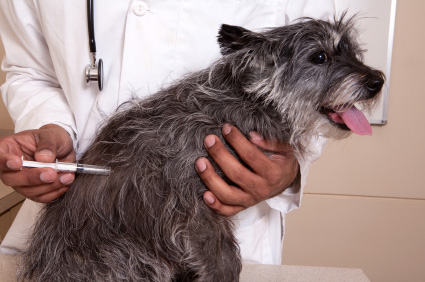
In 1981, three years after the first devastating Parvovirus outbreak, vaccines to curb the epidemic entered the market. Soon after, vaccines against Bordetella, Coronavirus, and Lyme disease became available. More recently, protection against Giardia and new strains of Leptospirosis has been introduced. We even have vaccines to combat dental disease and protect against rattlesnake bites.
The availability of all these vaccines has created confusion for dog owners. Veterinarians regularly field questions such as “What vaccines are really needed?” And just as importantly, “How often do they have to be given?”
The American Animal Hospital Association (AAHA) made headlines in 2003 when it published its vaccination recommendations. The group decided that some vaccines are absolutely necessary, others are only required in unique circumstances, and yet others should not be given at all. They also recommended moving the “annual” vaccine to every three years. They re-confirmed these recommendations in 2006.
To understand these recommendations, it helps to know what diseases we can prevent with vaccines. This information is in the accompanying table.
The panel agreed that Parvovirus and Distemper are devastating, life-threatening diseases and all dogs should be vaccinated against these viruses. Because Rabies is invariably a fatal disease once signs develop, every dog should receive vaccinations against it.
Adenovirus vaccines induce protection against hepatitis. They also create immunity against a mild disease called tracheobronchitis.
The AAHA has determined that these four diseases (all but tracheobronchitis) are severe diseases and occur with enough frequency to constitute the “core” vaccines. They should be administered to every dog.
AAHA also designated a group of vaccines as “non-core”. These include Parainfluenza, Bordetella, and Lyme Disease. These are used under special circumstances where exposure to the disease is likely.
The AAHA also stated that some vaccines are not recommended. For example, too few dogs succumb to Coronavirus to justify vaccination. Even when the disease does occur, it is mild and self-limiting. Studies suggest that puppies not given the vaccine had no increase in clinical signs than those that were vaccinated.
Leptospiral vaccines have a low efficacy (less than 75 percent) and most do not provide protection against the strains that currently cause disease in dogs. Giardia vaccines are also not endorsed by the AAHA. Though they may prevent shedding of the organism in the urine, they do not prevent infection.
The vaccines that protect against dental disease and rattlesnake venom are new to the market. The AAHA takes no position on them, but concludes there is a “reasonable expectation of efficacy”.
Even with this information, some dog owners are still confused. The easiest way to figure it out is to look at the risk your dog has for picking up each disease.
The combination vaccine containing Distemper, Parvovirus, and Hepatitis is standard, as well as Rabies. The rest of the vaccines are considered on a case by case basis. The decision to include them or not can be based on your veterinarian’s recommendations or through information gleaned from articles such as this one.
For example, Lyme disease (Borrelia) is only a hazard if your dog is going to be exposed to ticks. If your dog only walks down the street, there is no point in giving this vaccine. Conversely, a dog that goes on field trials might be a candidate for the vaccine, but only if Lyme disease is in the area.
Similarly, Bordetella is only picked up with direct dog-to-dog contact. If your dog does not see other dogs on his walks, and never goes to kennels or groomers, this disease is not a concern.
If your dog walks in areas where he can drink water or go swimming, the Giardia vaccine might be justified. As well, Leptospirosis originates from contaminated urine and can be picked up from water.
The vaccine against rattlesnake venom is designed to protect against bites of the Western Diamondback Rattlesnake. It may protect against the bite of the Eastern Diamondback Rattlesnake, but there is question about the Mojave Rattlesnake. The vaccine to fight periodontal disease is very new and many veterinarians are unsure of when to use it.
Another way to decide on vaccines is to find out whether or not certain diseases are a problem in your area. Ask your veterinarian when the last time he saw a case of the disease in question.
Frequency of re-vaccination has been a hot topic for several years. Some veterinarians are uncomfortable extending the vaccine interval past the traditional one year. Others embrace the AAHA recommendation to give the “Distemper combination” vaccine every three years. In fact, this is being taught at veterinary colleges and is becoming the standard. To back this up, immunity to Distemper and Parvovirus is believed to persist at least three years. In fact, recent studies suggest that it could last for seven years.
Rabies vaccines are usually given once to puppies, boosted a year later, and then administered every three years. The booster frequency is sometimes modified to conform to state regulations.
Protection from Bordetella only lasts nine to 12 months so it should be done annually or more often if there is a high risk (such as attending dog shows).
When creating a vaccination program for your dog, discuss what is needed with your veterinarian. Make a reasoned decision based on fact and what your dog truly needs. To see the complete American Animal Hospital Association vaccine guidelines, go to http://www.aahanet.org/resources/guidelines.aspx and look for “2006 AAHA Canine Vaccine Guidelines Revised”.
Available Vaccines and their Disease
Distemper: Causes pneumonia and seizures (hence the name distemper). Picked up by contact with secretions from an infected dog’s nose. Treatment is difficult and most die.
Parvovirus: Causes vomiting and diarrhea. Transmitted by exposure to contaminated feces. Treatment is intensive, requiring intravenous fluids and medications. Younger pups are more likely to die than older dogs. Mainly a disease of unvaccinated puppies/dogs.
Hepatitis (Adenovirus): Causes fever, vomiting and diarrhea. Virus is found in feces and saliva. Treatment consists of aggressive fluid therapy. Often fatal.
Parainfluenza: Causes coughing and sneezing. Transmitted by nasal secretions. Antibiotic treatment helps speed recovery.
Leptospirosis: Causes kidney and liver disease. Picked up from water contaminated by infected urine. Many infections go unnoticed. Severe infections often fatal.
Coronavirus: Causes vomiting and diarrhea. Transmitted by infected feces. Most dogs recover without treatment.
Lyme disease: Causes fever and joint inflammation. Transmitted by ticks. Treatment usually successful with antibiotics.
Giardia: Causes diarrhea. Picked up by drinking contaminated water. Treated with antibiotics.
Bordetella: Causes coughing and sneezing. Transmitted by nasal secretions. Antibiotic treatment helps control symptoms.
Rabies: Causes nervous signs. Transmitted by bites from infected animals. Treatment unsuccessful.
Dental Disease: The vaccine may reduce periodontal disease. Not fatal.
Rattlesnake Bites: The vaccine protects against rattlesnake venom. Can be fatal.
For more information contact Dr. Jeff Grognet or Dr. Louise Janes at
Mid-Isle Veterinary Hospital
5-161 Fern Road West
Qualicum Beach, BC
Tel (250) 752-8969