
Canada Rising: We Will Not Tolerate Bullies
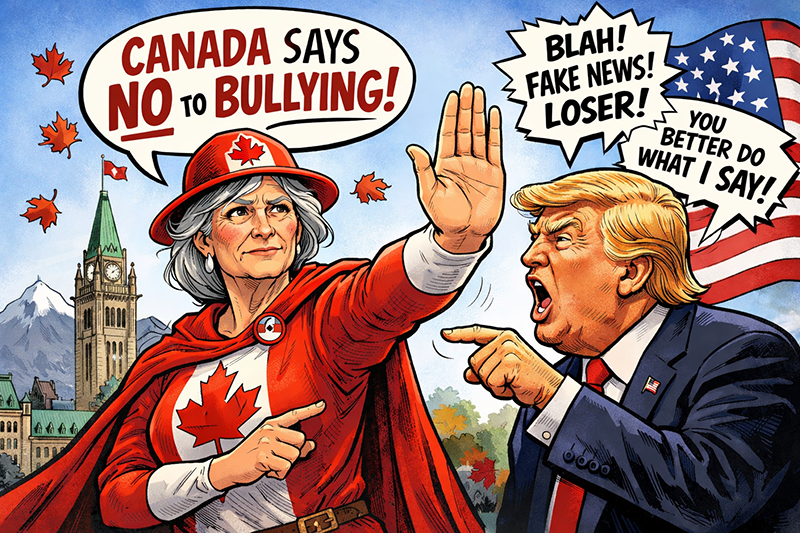
When asked, many Canadians struggle to define what being “Canadian” means, but one unifying sentiment is clear: we stand up to bullies.
We did so during World War II when we joined our Western allies to defeat Hitler’s Germany. We stood up again in Korea, where nearly 27,000 Canadian soldiers joined the United Nations mission to push back North Korean aggression and defend South Korea’s right to self-determination. During the Suez Crisis in 1956, Canada didn’t send troops but made its voice heard. Then-External Affairs Minister Lester B. Pearson proposed the creation of the first large-scale UN peacekeeping force to de-escalate the conflict—standing up to colonial powers Britain and France, as well as Egypt, in favour of diplomacy and peace. For this, Pearson received the Nobel Peace Prize. .
Later, we became one of the earliest and most consistent voices calling for sanctions against apartheid South Africa, standing on principle even when some allies hesitated. And in 2001, after the attacks on 9/11, Canada joined its NATO partners in Afghanistan, committing troops for over a decade to fight terrorism and support democratic institutions.
This track record of standing firm—often quietly, always deliberately—speaks to the essence of Canadian character.
And now, we are being tested again.
This time, the bully isn’t on a battlefield—it’s across the border. We are standing up against economic warfare waged by U.S. President Donald Trump, who returned to the White House with a mission to punish countries he claims are “ripping off” America—Canada among them. It started with complaints about our dairy supply management, lumber exports, and digital policies. Then came insults: Trump mocked Canada as the “51st American State” and threatened to cripple our economy with a blanket 35 per cent tariff unless we capitulated to a new deal on his terms.
True to form, we didn’t respond with outrage or panic. We got busy.
In Ottawa, political unity emerged. Major federal parties set aside their differences to pass a motion condemning Trump’s ultimatum and reaffirming Canada’s sovereignty. This symbolic show of unity signaled that economic coercion would not fracture our country—it would harden our resolve.
The Canadian government responded swiftly with dollar-for-dollar retaliatory tariffs. American exports like steel, aluminum, bourbon, and motorcycles—especially from politically sensitive states—were targeted. At home, Canadians embraced a surge of patriotism through grassroots “Buy Canadian” campaigns. Local retailers showcased Canadian-made goods, and consumers proudly supported domestic products. It wasn’t just economic; it was a national declaration of independence.
Provincial premiers, regardless of ideology, coordinated economic responses. They pooled legal and financial resources, invested in diversification, and created funds to support affected workers. Internationally, Canada ramped up trade talks—finalizing deals with the European Union (CETA), the UK post-Brexit, and Pacific Rim nations via the CPTPP. These agreements reduced our economic reliance on the U.S. and opened new doors for Canadian exports.
We also took the battle to the World Trade Organization, filing legal challenges against the U.S. tariffs and asserting our rights under international trade law. Canadian diplomats launched a coordinated media effort, appearing on global networks to counter Trump’s rhetoric with calm, fact-based messaging. Where Washington blustered, Canada calmly defended its reputation as a fair, principled trading nation.
Recognizing the need for structural change, the federal government introduced targeted grants to help small and medium-sized businesses shift toward new markets. Canadian companies began attending global trade shows, rebranding for international buyers, and investing in logistics networks outside North America. These weren’t just reactions—they were long-term strategic pivots toward a self-sustaining economy.
Nowhere is this pivot more visible than in Canada’s steel and aluminum industries. Once heavily dependent on the American market, Canadian metal producers began shipping directly to Europe, Asia, and South America. Thanks to new trade deals, exports are flowing to Japan, South Korea, Germany, and beyond. At home, a surge in infrastructure and green technology investment—everything from battery plants to transit lines—created fresh domestic demand for Canadian steel. Some producers went further, shifting to value-added manufacturing, making finished goods that kept more wealth and jobs in Canada.
And perhaps the most powerful symbol of our newfound independence lies in Kitimat, British Columbia.
There, Canada’s first major LNG export terminal is now operational. The $40 billion LNG Canada project has launched Canadian natural gas directly into global markets without routing through the U.S. Gulf Coast. No more relying on American ports, pipelines, or pricing. With access to Asia via the Pacific and powered by clean hydroelectricity, Kitimat gives us a faster, cheaper, lower-emission path to global buyers—an edge over our U.S. counterparts shipping through the crowded Panama Canal.
The first shipment in June 2025 wasn’t just gas—it was a message. Canada is now a serious competitor in global energy markets. And with planned expansions and new projects like Cedar LNG and Woodfibre LNG on the horizon, we’re not just playing catch-up—we’re building a foundation for long-term energy leadership.
Moreover, Kitimat proves that we can build large-scale infrastructure entirely within Canada, in partnership with Indigenous nations like the Haisla, and attract international investment on our own terms. Where once our gas flowed south to be sold back to the world, it now sails from our own coast under our own flag.
Through all of this, Canadians proved—once again—that we don’t fold under pressure. We don’t posture. We organize, we adapt, and we push forward. Our quiet determination and unified response to Trump’s economic threats are not signs of weakness—they’re hallmarks of strength.
In the end, this economic war may be the very thing that breaks our over-reliance on the American market. It’s forcing us to innovate, diversify, and define our place in the world not as America’s shadow, but as a sovereign, confident nation with its own voice, value, and vision.
We’re not just surviving the storm— we’re building a stronger Canada because of it.

Mathieu Powell/Editor.