

Dr. Jeff Grognet DVM & Dr. Louise Janes DVM May 2009

Current Article ∙ Archive ∙ Back to Island Voices
Crossing Borders
by Jeff Grognet, DVM, BSc (Agr) and Louise Janes, BSc(Agr), DVM
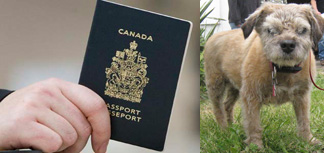
Though permanent identification such as a tattoo or microchip is not essential for travel between the US and Canada, it is a practical requirement. If your friend gets away from you while you are far from home, you won’t get him back without ID. A microchip is the best form of permanent ID for US travel, but your dog should also carry a tag on his collar with his name as well as your name and phone number.
A rabies vaccination is a must for crossing the border. You need proof that your dog was vaccinated against rabies by a licensed veterinarian. A signed, dated certificate must show the vaccine was given at least 30 days prior to entering the US. It must list you as the owner, but it must also contain a clear description of the dog that will allow him to be identified. His colour, breed, sex, age, and specific markings must be detailed.
Information on the brand of rabies vaccine, the vaccine lot number, and the expiry date of the vaccine must also be written on the certificate. In adult dogs, rabies vaccinations are valid for either one or three years. If an expiry date is not indicated, the vaccination is presumed to be valid for one year after administration.
If dogs are less than three months old when crossing the border, they don’t need to be vaccinated against rabies. If you are traveling with a young puppy that is large or looks mature, you should carry proof of his age when entering the US. A health certificate or vaccine certificate (not rabies) that is dated and includes the pup’s age should be adequate for this purpose.
As you can see, these regulations present a logistical problem. Puppies can’t have a rabies vaccination until they are three months old (based on rabies vaccine label directions), yet they need to have the vaccine a month before they travel into the US. If you have a three and one-half month old puppy, what do you do?
For clarification, I called the Bellingham Border Crossing to get an answer. I was told that border personnel don’t enforce the 30 day rule, but a valid rabies certificate is absolutely required because the pup is over three months old.
When you are traveling back into Canada, you will find that the border requirements are similar to the US. To cross the Canadian border, your dog does not need permanent identification. If he is under three months old, he does not require a rabies vaccination.
The difference with the Canadian authorities is that they consider a rabies vaccination valid from the day it is given. In other words, you can vaccinate your dog and cross the border into Canada a few minutes later.
It is not necessary for your dog to have a health certificate when you are traveling in a car across the US/Canada border. When flying, you may or may not need a health certificate, depending on your airline. The duration of validity of health certificates also varies from airline to airline. It’s best to ask them for their current requirements.
For easy travel, carry a rabies certificate for your dog and a passport for yourself.
**********************************************************************
Web Links Information Sources for Traveling Across the Border
Entering the United States
Centers for Disease Control and Prevention
http://www.cdc.gov/ncidod/dq/animal.htm
US Customs and Border Protection
http://www.cbp.gov/xp/cgov/travel/vacation/kbyg/prohibited_restricted.xml#Pets
Border Crossing Information (Bellingham) 360-332-6318
Returning to Canada
Canadian Food Inspection Agency http://www.inspection.gc.ca/english/anima/heasan/import/dog_chien_3e.shtml
Canadian Border Services Agency 1-800-461-9999
For more information contact Dr. Jeff Grognet or Dr. Louise Janes at
Mid-Isle Veterinary Hospital
5-161 Fern Road West
Qualicum Beach, B.C.
Tel (250) 752-8969