

Dr. Jeff Grognet DVM & Dr. Louise Janes DVM April 2010
Current Article ∙ Archive ∙ Back to Island Voices
Degenerative Myelopathy in German Shepherd Dogs
by Jeff Grognet, DVM, BSc (Agr) and Louise Janes, BSc(Agr), DVM
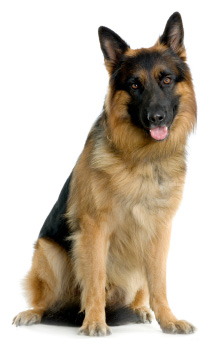
DM causes progressive ataxia—dogs between 5 and 14 years old begin to lose control of their back end as his spinal cord and nerve function deteriorates. Sometimes the disease is “heard” before it is seen. As the dog loses his ability to pick up his hind legs, his nails scuff along the pavement.
Later, the dog begins crossing his feet and sways when he turns as if in a drunken stupor. Eventually, he has trouble keeping his back end up as his leg muscles wither away.
The course of DM is different in each dog—it can be relentlessly progressive over just a few months, or it can wax and wane for years. Most dogs retain control of urination and defecation until very late in the course of their disease. DM does not affect the forelegs.
Though DM is a neurological disease with no radiological abnormalities, veterinarians still take radiographs. It is important to check for other spinal diseases like disk herniation, tumors, or vertebral arthritis that cause similar symptoms. Ultimately, the diagnosis of DM is made after other diseases have been ruled out. The only way to positively identify DM is on post mortem examination of spinal cord tissue.
Why does spinal cord tissue degenerate in certain dogs? Most researchers agree it is an aberrant immune reaction to proteins in the spinal cord—the body is attacking its own nervous system. This has been proven by finding antibodies in the spinal cords of dogs with DM. Unfortunately, these antibodies are not specific for DM—they are found with most inflammatory diseases of the central nervous system. However, the presence of antibodies combined with the classic symptoms usually supports a diagnosis of DM.
According to R.M.Clemmons, a veterinary neurologist at the University of Florida Veterinary College, DM cannot be cured but it can be managed with exercise, diet, supplements and medications.
Exercise helps maintain muscle mass and is the reason many dogs can still walk late in the course of DM. The best exercise program for DM is an increasing schedule of alternate day exercise—either swimming or walking. For instance, dogs are exercised for 5 to 10 minutes every second day for two weeks. Gradually, the length of the exercise period is increased until the dog gets two long (30 minute) workouts each week while maintaining the less strenuous days in-between. If the dog becomes sore, painkillers may be needed to keep him comfortable so he can do the exercise.
Diet is also believed to have an impact on the course of DM. Clemmons recommends a homemade diet (see below). To one serving of this diet, he adds: 1 tsp ground ginger, 2 raw garlic cloves, ½ tsp dry mustard, and 1 tsp bone meal.
Clemmons also recommends vitamin supplements. These include vitamins B, E and C. In fact, he recommends giving all German Shepherd dogs vitamin E, starting in puppyhood. He suggests 400 units for dogs under 2 years of age and 800 for older dogs. He gives his patients with DM 2000 units of vitamin E daily.
Other supplements that may be beneficial in managing DM include selenium, omega fatty acids, gammalinolenic acid, lecithin, and coenzyme Q10. There is also a host of herbs that can help dogs with DM, such as ginseng, ginkgo and grape seed extract. Dosing information is provided on web site:
http://neuro.vetmed.ufl.edu/neuro/DM_Web/DMofGS.htm
Two specific medications—aminocaproic acid and n-acetylcysteine—may prevent the progression of DM or even trigger a remission. These compounds are prescribed by a veterinarian.
Unfortunately, even with rigorous adherence to Clemmons’ program, there are no guarantees that a dog with DM will respond. The success rate is better if dogs are started early in the course of their disease. However, the future may hold greater promise for dogs predisposed to DM. The effect of supplementation in young dogs as a preventive for DM is now being explored.
Homemade Diet for Dogs with DM
This quantity provides the nutrients for a 30 to 50 pound dog. An 80 pound dog may need 1.5 to 2.5 times this amount.
2 oz boneless pork (cooked)
4 oz tofu
8 oz long grain brown rice
2 tsp extra virgin olive oil
¼ cup molasses
2 whole carrots (boiled)
1 cup spinach (cooked)
4 tbsp green bell pepper (cooked)
4 broccoli spears (cooked)
For more information contact Dr. Jeff Grognet or Dr. Louise Janes at
Mid-Isle Veterinary Hospital
5-161 Fern Road West
Qualicum Beach, B.C.
Tel (250) 752-8969