

Dr. Jeff Grognet DVM & Dr. Louise Janes DVM November 2010

Current Article ∙ Archive ∙ Back to Island Voices
Heartworm in Dogs
by Jeff Grognet, DVM, BSc (Agr) and Louise Janes, BSc(Agr), DVM
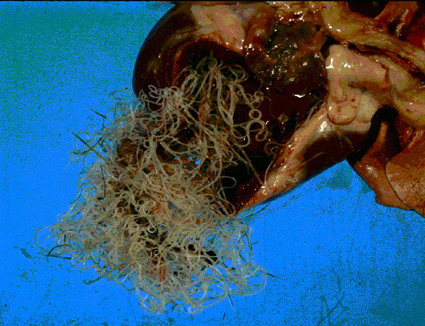
Today’s veterinarians are much better educated about this disease. Most importantly for the health of their patients, they know how to prevent it. But they still find dogs with the parasite. The reason – some dog owners have a poor appreciation of the seriousness of heartworm and they don’t put their dogs on preventives. Their dogs become infested and, besides the threat to their dogs’ lives, it puts all other dogs at risk.
Contrary to what the name suggests, heartworms prefer to live in the pulmonary arteries leading from the heart to the lungs rather than the heart itself. The worms bathe in and feed on the blood, reproduce, and release thousands of microscopic young into the bloodstream. These young (microfilariae) drift in the blood, waiting for a mosquito to take a blood meal and pick them up. It’s only in a mosquito that they can mature into larvae.
If it’s warm enough, it takes just two weeks for the larvae to be ready to infest the next mammalian host. As the mosquito sucks blood, the larva charges down its salivary duct into the host’s body. This could be a dog, a cat, or a human. In dogs (and cats), the larvae begin a six to seven month migration, meanwhile changing into an adult heartworm. Adult worms can live up to seven years.
When a heartworm larva is injected into a person, it usually ends up in the lungs where the body creates a cyst around the invader. This does not cause a medical problem, but it can be mistaken for lung cancer.
In dogs, contrary to what you’d think, worms don’t physically block the flow of blood. Instead, they create inflammation in the arterial wall. It thickens and this disrupts blood flow, making the heart work harder.
Once there is sufficient slowing of blood flow, a heartworm-infested dog develops a mild, persistent cough, may fatigue after only mild exercise, and suffers from a reduced appetite. The end result can be heart failure.
Though veterinarians look for typical signs – weight loss, poor muscling, and a scurfy coat – to suggest a heartworm infestation, most dogs harboring this parasite do not have clinical symptoms. This is because the worms are detected before they cause symptoms by screening tests carried out prior to putting the dog on preventives.
Heartworm testing itself has advanced considerably in the last 20 years. Back then, veterinarians used to look for microfilariae on blood smears under the microscope. Seeing writhing worms magnified 400 times looks impressive, and it is certainly a positive diagnosis of the disease, however, 20 percent of heartworm-infested dogs do not have circulating microfilariae. This means the infestation can be missed. With this inaccuracy, this test has fallen into disfavor.
The screening test veterinarians use today detects heartworm antigen (minute amounts of protein, or more correctly, cuticle from the surface of the adult heartworm). It is so sensitive that it can detect a single worm in a dog’s body. This test is often done while waiting in the veterinarian’s office.
Because the test can only detect the presence of adult heartworms, the timing of a heartworm test is extremely important. Remember that it takes up to seven months for a worm to change from a minute larvae to an adult. This means the test can’t be done until at least seven months after the last period of heartworm transmission.
So, if the temperature in your area was warm enough for heartworm transmission in September, testing should be done, at the earliest, the beginning of April. There is also no point in testing puppies under seven months of age, even if they were born in heartworm season.
If a dog has heartworm, treatment is complicated and expensive. Veterinarians use an insecticidal drug to kill the worms. The dog must be kept quiet during treatment to decrease the risk of dying worms blocking blood flow to the lungs and triggering heart or breathing problems.
There are many options for heartworm prevention (see sidebar). They include daily and monthly tablets and chewables, and monthly topicals. All of these medications are extremely effective. They interrupt development of the larvae so that they can’t mature into adult worms. For them to work, it is essential that dogs are medicated according to a prescribed schedule.
Heartworm Prevention
Just over two decades ago, the only medication available to prevent heartworm infestation was diethylcarbamazine (DEC). It killed heartworm larvae by paralyzing their nervous systems. It had to be given daily so that larvae picked up each day would be killed. If more than two days were missed, larvae injected by mosquitoes during that period would go on to mature into adult heartworms, even with the re-institution of daily medication.
The real problem with DEC is that if it is given to a dog with an undiagnosed heartworm infestation, sudden death of the parasites could trigger a severe, often fatal, allergic reaction. For this reason, all dogs had to be tested for a heartworm infestation before starting medication.
Heartworm prevention programs changed dramatically when new preventatives were introduced. These medications include ivermectin (HeartgardR), milbemycin oxime (InterceptorR and SentinelR), selamectin (RevolutionR), and imidacloprid/moxidectin (Advantage MultiR). Unlike DEC, these medications have a much larger degree of safety, and only need to be given monthly.
These medications work by killing larval stages injected by mosquitoes over the previous month (or more). Given time, they also kill microfilariae (immature larval stages produced by adult heartworms). They are safe to use if a dog is carrying heartworm and, in fact, are recommended as part of an adult heartworm treatment program.
If you live in a heartworm region, you probably know it. If you are unsure, talk to your veterinarian. Find out if there have been any dogs diagnosed with heartworm in your area. If this disease has made an appearance in your vicinity, plan on giving your dog preventative medication to protect him.
Heartworm – To Prevent or not to Prevent?
There are three things needed for heartworm to be a threat to your dog. You need dogs infested with heartworm, mosquitoes to carry it between dogs, and the right temperature. If any one of these three is missing, heartworm is not a threat.
Domestic dogs and wild canids (coyotes, foxes, wolves) are all hosts for heartworm. This means that if any of these “dogs” harbour heartworm adults (producing microfilariae), they are a source of infestation.
There are many mosquito strains and most are capable of transmitting heartworm. This means they can extract a microfilaria from an infested dog, the larva can mature in them, and they can inject the infective larva into a new canine host.
Even when the first two requirements are satisfied, the third factor – temperature – can promote or stop transmission. For heartworm larvae to mature in a mosquito, the temperature must remain above 57 degrees F. The occasional emergence of overwintering mosquitoes on warm (winter) days does not represent a risk of infection. The time period for maturation of a microfilaria to an infective larva inside a mosquito takes about 29 days at 64 degrees F and eight days at 86 degree F.
Most areas of the US are too cold in the winter to allow heartworm larvae to develop. In southern Ontario (Canada), the transmission period each year is only a few months. Most of Canada is free of this parasite.
In Florida, transmission of heartworm cannot occur between mid-December and mid-April. In most of the US, it is probably limited to no more than six or eight months. With the possible exception of some areas in the deep South, there is no scientific justification for keeping dogs on heartworm preventive year-round.
For more information contact Dr. Jeff Grognet or Dr. Louise Janes at
Mid-Isle Veterinary Hospital
5-161 Fern Road West
Qualicum Beach, B.C.
Tel (250) 752-8969