

Dr. Jeff Grognet DVM & Dr. Louise Janes DVM February 2011

Current Article ∙ Archive ∙ Back to Island Voices
Feline House-soiling
by Jeff Grognet, DVM, BSc (Agr) and Louise Janes, BSc(Agr), DVM
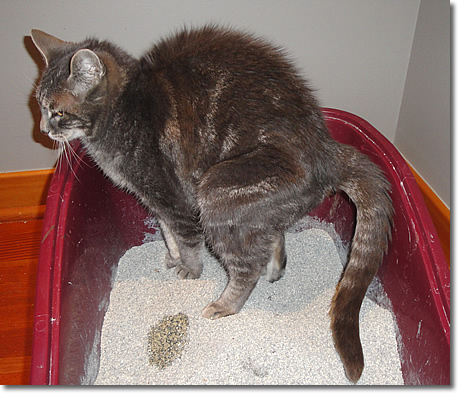
The problem is that house-soiling is only a symptom. You need to find the cause. There are a few bits of information you need to gather to figure this out.
Let’s start with the litter box. Cats can be very fastidious and very territorial, so if they don’t like the box, or if they have to compete to use it, they might just skip it altogether.
So let’s do a litter box check:
Is the litter box dirty? When the litter box is dirty, the cat seeks out a cleaner place to relieve itself—often the carpet or the bed. Litter boxes should be scooped daily and washed weekly with mild dish detergent (soap that rinses off easily and does not leave a lingering scent).
What are the sizes and shapes of the litter boxes? Most cats prefer large, uncovered litter boxes because they can get in them and turn around. If your cat likes to scatter litter when digging, high sides can help confine the mess. If your cat is old, arthritic, or small, his box should have low sides.
Does the litter box have a cover? Covered litter boxes keep the litter out of sight, but they also trap odors. If you want to use one, keep it exceptionally clean. You could remove the lid and use the bottom half.
What kind of litter are you using? Most cats prefer fine-grained, unscented litters. Scoopable litters that clump are easy to clean, but some cats get the litter material stuck in the hair between the pads of their feet. Scented litters, though nice for us, may repel cats. Some people have success with wood pellets for litter, which are absorbent and can be composted. Once you find a litter your cat likes, don’t change it. If you want to try a new litter, give your cat a choice—one box with his regular litter and one with the new product.
Where is the litter box located? Cats need privacy when toileting, so the litter box should be in a quiet yet accessible location where pets and people can’t sneak up. Don’t put it out in the open or in a busy hallway. How many litter boxes are there? You need to have at least one litter box per cat in your home. The number of litter boxes in a house should be the number of cats plus one. Multilevel homes should have a box on each floor. A convenient box is a well-used box.
Rule of Thumb
If you see an old cat that has never had problems start missing his box, suggest an examination. The cat could be in pain.
Next, pay attention to what the cat has actually done. There are two possibilities: Urination is done to empty a full bladder. Indoor urination is usually on a horizontal surface and the cat squats to do it. The tail is normally kept down. Elimination usually occurs in quiet secluded areas.
Spraying (or marking) is done to signal ownership of a territory. The cat backs up to an object and marks (usually) a vertical surface. He holds the tail upright, and the tip quivers. Marking is done in plain view (that’s the point of it).
And just to break a myth, both males and females can spray. Males just tend to do it more often.
Now that we have the basics on litter boxes, let’s go back to our case and solve it. The cat is not urinating on a horizontal surface. If he were, we’d suspect a bladder infection, possibly tied to bladder crystals. With bladder problems, they urinate more often and you may see a blood tinge in the urine.
The cat is using the corner of a couch, which is vertical. The other big clue here is that there’s a new cat in the house. Similar circumstances occur when an outside cat is around the house (or in your cat’s territory). We would assume this cat is marking.
The way I think about this is that the indoor cat is trying to tell the threatening cat to go away by saying “this is my home.” In this case, the cat may be upset because the owner added a second cat, or he might be marking because the owner let the litter box get dirty.
To treat this, we can try to remove the triggers for the marking. If we assume it’s due to the new cat, we could try to decrease the tension between them by adding extra litter boxes.
You can also get the cat thinking differently about the function of the place he has marked. Put a litter box there, or even the food and water bowls. Some people put physical barriers in place. If the cat is urinating on a bed, close the bedroom door.
If the cat is climbing on the counter and using that as a toilet, putting a sheet of aluminum foil on the surface can deter them from jumping up. They don’t like the feel on their feet (or perhaps the sound).
There are novel treatments for house-soiling that we can also try. One of these is pheromones. Feliway is a synthetic copy of the feline facial pheromone used by cats to mark their territory. It helps some cats feel more relaxed so they don’t housesoil. We find the diffuser works better than the spray as it keeps a constant level in the environment. We can also dispense medication, but these psychotropic drugs should only be used in conjunction with retraining.
Whatever course of action you take, make sure you don’t punish the cat. This creates more problems than it cures, as the cat may mark in hard-to-detect places.
Web Link
The litterbox from a cat’s point of view (great information on the toileting habits of cats and how to keep them using a box). http://www.catinfo.org/?link=litterbox
For more information contact Dr. Jeff Grognet or Dr. Louise Janes at
Mid-Isle Veterinary Hospital
5-161 Fern Road West
Qualicum Beach, BC
Tel (250) 752-8969